Still struggling to choose which hydraulic jack to buy? Is a 3-ton floor jack or a 5-ton bottle jack more suitable for your auto repair shop? Is a pneumatic jack really worth twice the price? What special problems can a separable jack solve? This comprehensive guide answers all your questions in one article, from household to industrial grade, from daily maintenance to heavy engineering, helping you accurately match your needs and avoid wasting money.
Introduction
Hydraulic jacks are indispensable core tools in automotive repair, industrial maintenance, construction engineering and other fields. Using Pascal's principle, they can generate enormous lifting force with minimal human effort, helping us easily complete heavy object lifting, equipment disassembly, vehicle maintenance and other tasks.
However, faced with the wide variety of hydraulic jacks on the market, many purchasers often feel confused: What are the differences between floor, bottle, pneumatic and separable types? Which one should I choose for my workshop or project?
This article will comprehensively analyze four mainstream hydraulic jacks from four dimensions: working principle, advantages and disadvantages, applicable scenarios, and core parameters, helping you make the most suitable purchasing decision.
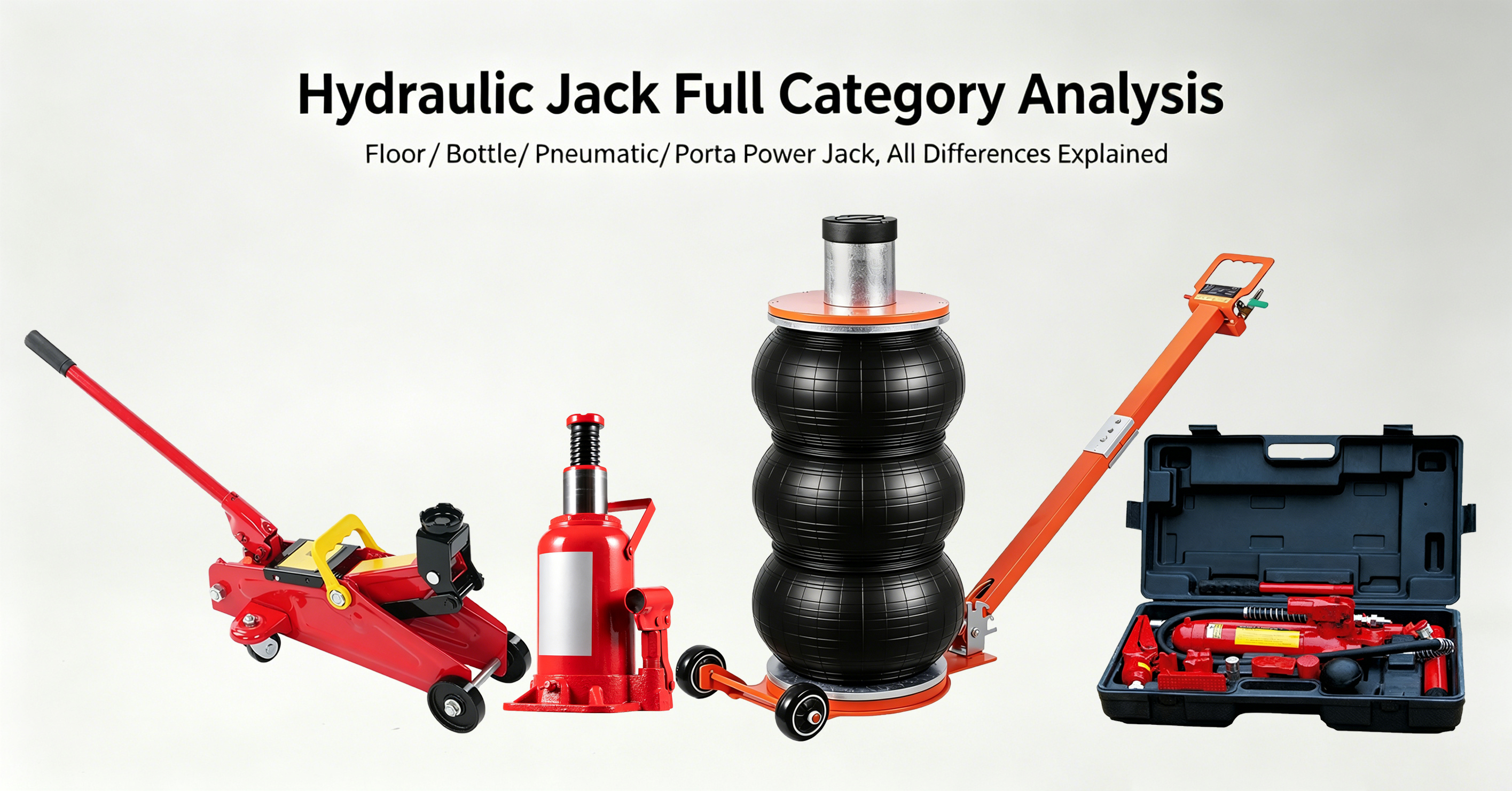
1. Floor Jack (Trolley Jack)
Working Principle: Adopts a horizontal structure, drives the hydraulic pump through a manual rocker, presses hydraulic oil into the cylinder, pushes the piston upward, thereby driving the lifting arm to lift heavy objects. Equipped with wheels at the bottom for flexible movement.
- Ultra-low profile: The minimum height is usually between 100-150mm, which can easily get under the chassis of most passenger cars and SUVs
- Flexible movement: Equipped with universal wheels and directional wheels, can move freely in the workshop and quickly locate to the lifting point
- Labor-saving operation: Long rocker design, anyone can operate easily
- Good stability: Wide base and long lifting arm provide better stability
- Limited lifting height, usually no more than 500mm
- Large volume, not easy to carry
- Not suitable for use on uneven ground
- Daily maintenance and tire changing for passenger cars, SUVs and light trucks
- Quick maintenance stations in small and medium-sized auto repair shops
- Auto modification shops
Typical Tonnage Range: 2 ton, 3 ton, 4 ton, 5 ton
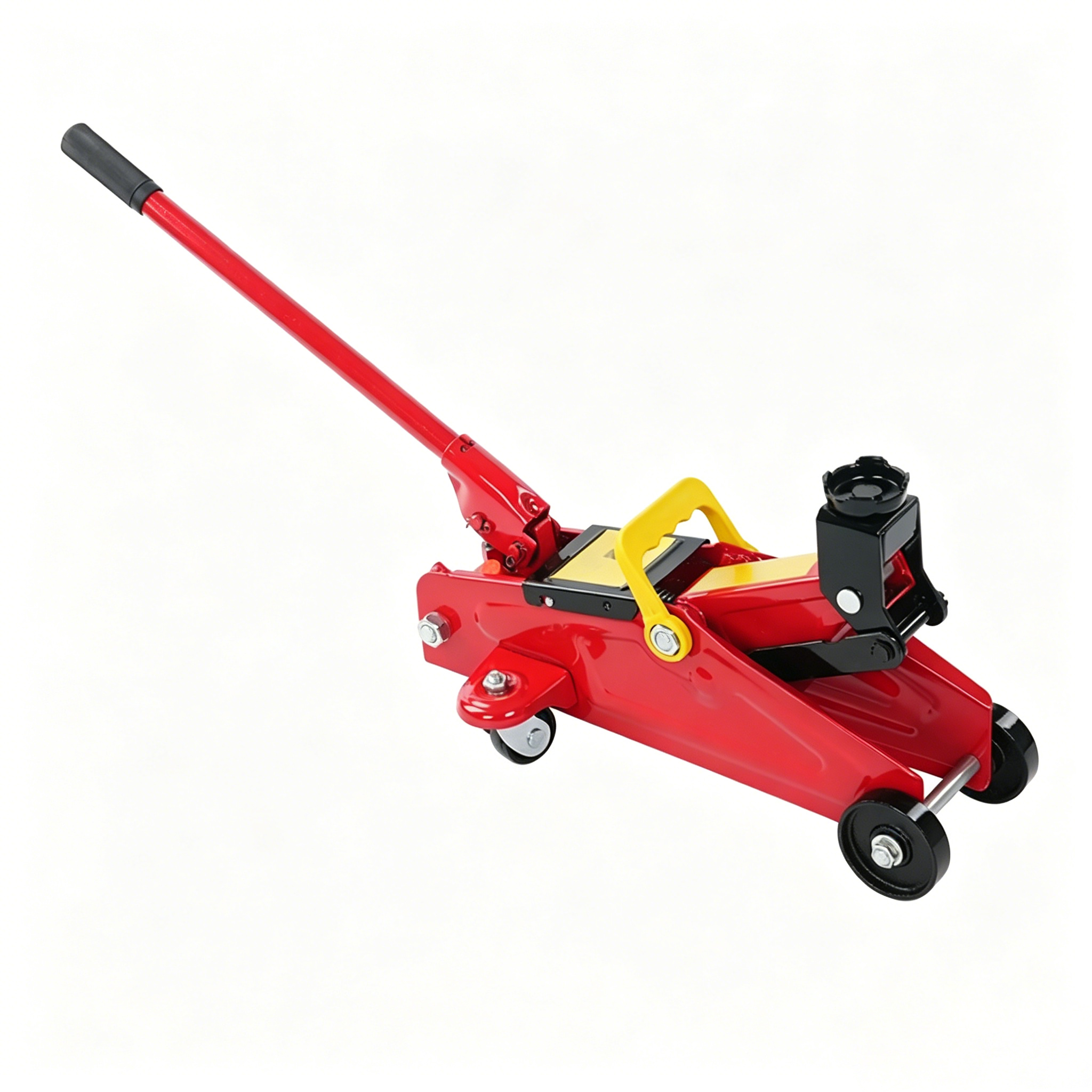
2. Bottle Jack
Working Principle: Named for its bottle-like appearance, adopts a vertical cylinder design, drives the hydraulic pump through a manual rocker, directly pushes the piston upward to lift heavy objects.
- Compact structure: Small size and light weight, easy to carry and store
- High lifting height: The maximum lifting height can reach more than 600mm, some models can be further increased by extension rods
- Strong load-bearing capacity: Small volume can achieve large tonnage, up to 100 tons
- Low price: The most cost-effective among the four types
- Higher minimum height, cannot get under sports cars and modified cars with low chassis
- Stability is not as good as floor jacks
- Relatively laborious to operate, large tonnage models require more effort
- Maintenance of trucks, buses and construction machinery
- Outdoor road rescue
- Temporary support in construction engineering
- Home emergency backup
Typical Tonnage Range: 2 ton, 5 ton, 10 ton, 20 ton, 50 ton
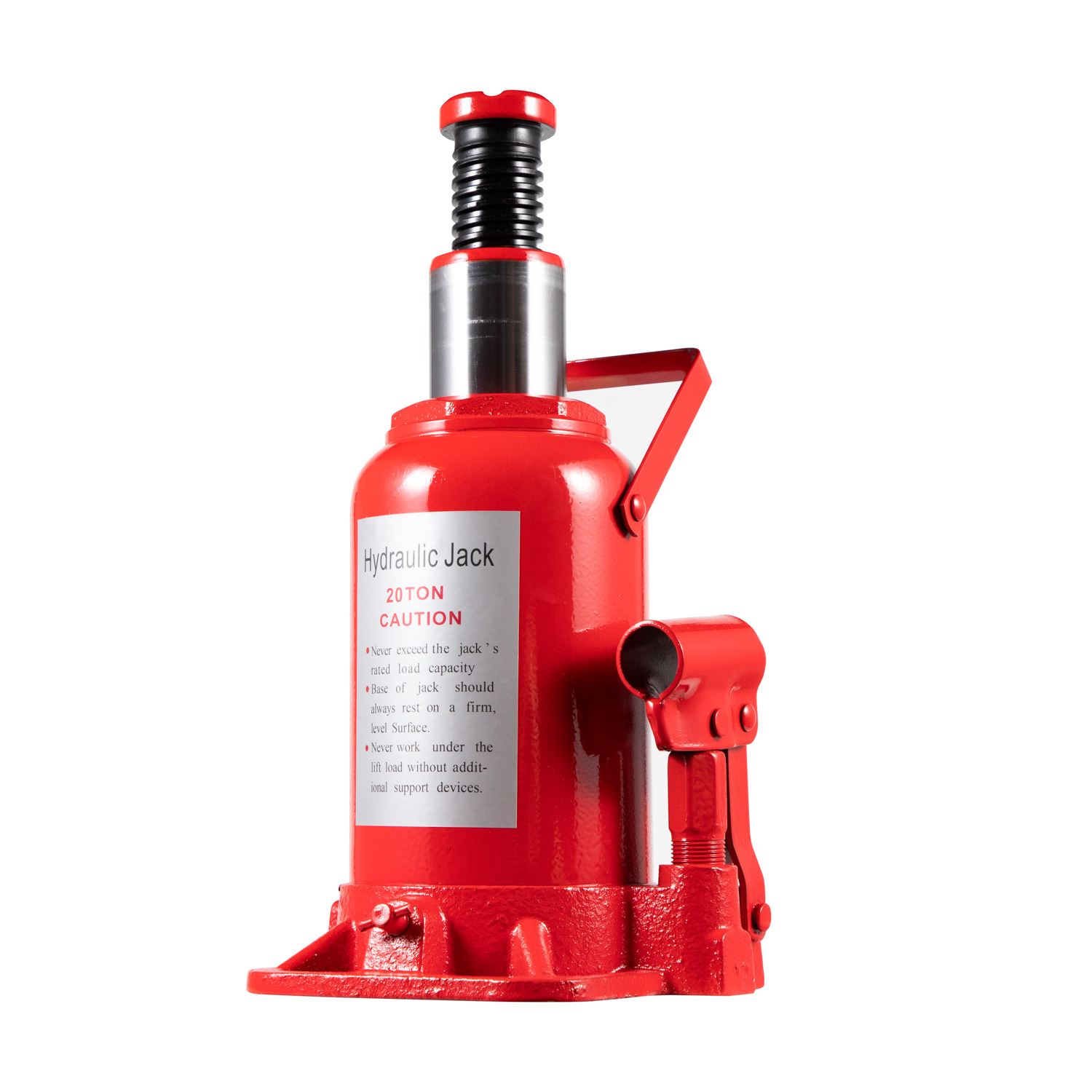
3. Pneumatic Hydraulic Jack (Air Jack)
Working Principle: Combines pneumatic and hydraulic technologies, uses compressed air as the power source to drive the hydraulic pump, thereby realizing the lifting of heavy objects. Some models also retain manual operation function for emergency use.
- Extremely high efficiency: Lifting speed is 3-5 times that of manual jacks, greatly shortening maintenance time
- Labor-saving operation: No need to manually shake the rocker, just control the air valve to complete lifting and lowering
- Strong load-bearing capacity: Common tonnage ranges from 10 tons to 100 tons
- Long service life: Reduces mechanical wear caused by manual operation
- Requires an air compressor to use
- Much more expensive than manual jacks
- Large volume and weight, not easy to carry
- Quick maintenance stations in large auto repair shops and 4S stores
- Truck and bus repair stations
- Construction machinery maintenance workshops
- Auto scrap yards
Typical Tonnage Range: 10 ton, 20 ton, 30 ton, 50 ton
4. Porta Power Jack
Working Principle: Commonly known as "separate jack" in the industry, consists of two parts: hydraulic pump and oil cylinder, connected by high-pressure oil pipes. The hydraulic pump can be manual, electric or pneumatic, pressing hydraulic oil into the cylinder through the oil pipe to push the piston upward.
- Extremely flexible: The oil cylinder can be placed alone in a narrow space, and the hydraulic pump can be operated from a distance
- Wide application range: Can be used for lifting operations at various special angles and positions
- Super load-bearing capacity: Up to more than 1000 tons
- Can be matched with various accessories: Such as extension rods, bent pipes, top caps, spreader jaws, etc., to meet different work needs
- Expensive
- Relatively complex to operate, requires certain professional knowledge
- Oil pipes are easy to damage and need regular inspection and replacement
- Auto body repair and frame straightening
- Installation and disassembly of heavy equipment
- Lifting and shifting of bridges and construction projects
- Ship maintenance
- Mining equipment maintenance
- Accident rescue
Typical Tonnage Range: 4 ton, 10 ton, 20 ton, 50 ton, 100 ton
Conclusion
Choosing the right hydraulic jack can not only improve work efficiency but also ensure the safety of operators. We hope this article can help you clearly understand the differences between the four mainstream hydraulic jacks and make the most suitable choice for yourself.
If you have any questions about hydraulic jacks or need to customize products with special specifications, please feel free to contact our professional team. We have 20 years of experience in hydraulic tool production, our products have passed CE, ISO and many other international certifications, and are exported to more than 50 countries and regions around the world.

